WC4 is a club of more than two hundred collectors in eastern Pennsylvania and New Jersey. We gather along the river George Washington crossed, to trade, auction, study, and share the small printed objects that hold the last century inside them.
Program: “Bicentennial of 1976” by Betty Davis.
Stan’s Contest: Most unusual occupation.
Auction: 60 club lots + member lots.
Doors 6:30 PM · Meeting 8:00 · Auction 9:00
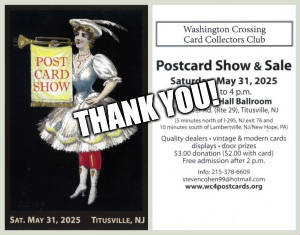
The Annual WC4 Postcard Show & Sale.
Union Fire Company, Titusville, NJ.
9:00 AM – 4:00 PM. Bring the $1 coupon →
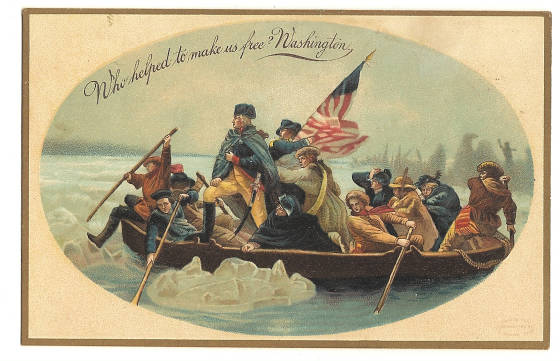
The Washington Crossing Card Collectors Club — known to friends as WC4 — was formed in 1972 by local postcard collectors in the Delaware Valley. Our name and heritage have always revolved around George Washington’s historic 1776 crossing of the Delaware River. Many of our founding members live in that area, and our meetings are still held there today. And — yes — some of us are history buffs, too.
The primary interest of our club is deltiology — the study and collection of postcards. Beyond the cards, the club is a place: a room where you can talk for an hour about a single Titusville bridge view or a Lambertville trolley card, and find someone who wants to listen, swap, and probably out-bid you.
Doors open and the bourse begins — dealers and members buy, sell, and trade postcards and supplies. Come early; the best lots leave quickly.
A presentation on some aspect of postcard collecting, illustrated with projected images. Members and guests alike are welcome.
Free refreshments, free door prizes, and Stan’s Contest — everyone enters one postcard on a monthly theme, and the room votes.
The evening closes with the auction — sixty club lots plus member lots (limit five per member). We usually wrap by 10:00 – 10:30, but guests are free to leave whenever they like.
If you’re not a member already, please consider becoming one. We have over two hundred members — mostly Delaware Valley, but also collectors from around the world. It’s a terrific group of interesting people. We’re very serious about our postcards, but we always enjoy meeting new people and making new friends.
Once a year the room fills with dealers, collectors, and visitors who came for one card and went home with twelve. Vintage views, real-photo cards, holiday sets, town histories, and the occasional unicorn.
Held at the Union Fire Company in Titusville, NJ — the same hall as our monthly meetings — from 9:00 AM to 4:00 PM.
Every monthly meeting closes with the club auction. Here is the actual lot list for the May 2026 sale — a quick tour through what our members are bringing to the table.
Each meeting has a theme. Everyone enters one postcard, the entries are projected on the screen, and the room votes. The prize money was, for a long time, supplied by Stan himself.
News, programs, member spotlights, upcoming auctions, and reports from the bourse. Mailed and emailed to members every month.
Through our founder Ted Bozarth, we became sister clubs with the Queensland Card Collectors’ Society in Australia. We didn’t know about it for years — we found out on the internet.
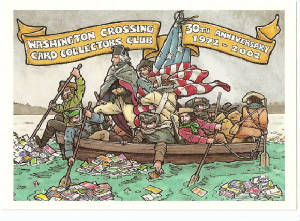
We commissioned cartoonist Rick Geary to draw a series of anniversary postcards for the club. His cards are $1 each at meetings — visit rickgeary.com for more.
A summer gathering with an auction and the kind of small-talk only postcard collectors are capable of.
A sit-down dinner and program, the formal cousin of the bourse. The Union Fire Company has been extraordinarily good to us; we say thanks here, often.
Postal regulations kept postcards from existing. Their direct ancestors were printed envelopes — comic, Valentine, musical — produced by Mulready, Hume, Doyle, and Valentine. Patriotic Covers appeared in great numbers during the U.S. Civil War. The first U.S. postal-type card was a privately printed card copyrighted in 1861 by J. P. Carlton, later sold as “Lipman Postal Cards.”
Dr. Emanuel Herrmann suggested the first postal card in 1869; Hungary adopted it that year. The first regularly printed card appeared in 1870 — a historical card from the Franco-German War. The 1893 Columbian Exposition cards in Chicago were the first U.S. cards printed expressly as souvenirs.
American publishers were allowed to print and sell cards bearing the words “Private Mailing Card, Authorized by Act of Congress on May 19, 1898.” Posted with one-cent stamps — the same rate as government postals — these PMCs unleashed the private postcard.
The U.S. allowed the words “Post Card” on the back of privately printed cards. Writing was still restricted to the face. England permitted the divided back in 1902; France 1904; Germany 1905; the United States, finally, in 1907.
Divided backs became near-universal. Most U.S. cards in this period were printed in Germany, regarded then as the master printers of the world. Rising tariffs and the approach of war ended that import line — and with it, the Golden Age.
American printers caught up. Quality was uneven; the market was saturated; greeting cards declined. View cards remained strong. The white borders, originally a way to save ink, became the era’s visual signature.
Cards printed on a linen-textured stock with vivid, almost lurid color. View cards and comics dominated. French-fold greetings displaced the older greeting card. Political-humor linens of this period are among the most collected of the era.
The Union Oils series of 1939 were the first chromes. Made of very small printed dots and a glossy finish, they are the postcards most of us grew up with and the ones still produced today.